Managing the apparel needs of a busy medical clinic, dental practice, or wellness spa requires balancing hygiene standards, team presentation, and budgetary constraints. Investing in high-grade wholesale medical apparel is a major operational commitment. However, even the highest-performing medical garments will degrade prematurely if subjected to harsh, improper commercial laundering. Establishing consistent, professional laundry protocols not only maintains pathogen control but also dramatically extends garment longevity. Learning how to clean, decontaminate, and preserve your wholesale scrubs and coats ensures your staff presents an immaculate image shift after shift while maximizing your practice's return on investment.
Pre-Treatment Protocols: Protecting Your Investment in Bulk Uniforms
The primary breakdown of medical fabrics begins long before garments enter the washing drum. In fast-paced healthcare settings, bulk uniforms endure routine exposure to biological fluids, chemical antiseptics, and oily ointments. Leaving these substances to set oxidizes fibers, permanently discolors textiles, and weakens structural integrity. Establishing an immediate, standardized sorting and pre-treatment routine protects wholesale uniforms from fiber degradation and cross-contamination.
- Perform Immediate Spot Cleansing: Treat biological stains such as blood or exudate using cold water and specialized enzyme detergents before the stain oxidizes. Hot water coagulates proteins, permanently bonding them to synthetic textile fibers.
- Turn Every Garment Inside Out: Turning tops and bottoms inside out prior to washing shields external surfaces from friction, preventing fabric pilling, seam fraying, and premature badge-loop deterioration.
- Sort Methodically by Color and Fabric Weight: Never wash heavily soiled surgical attire alongside crisp white coats. Separate deep tones, pastels, and bright whites into distinct cycles to avoid dye migration and lint accumulation.
- Empty and Inspect All Pockets: Ballpoint pens, iodine swabs, and metal surgical instruments left inside pockets cause catastrophic tears, drum abrasions, and permanent chemical staining during high-spin cycles.
Washing vs. Sanitizing: Step-by-Step Laundering for Wholesale Scrubs
Balancing effective sanitization with fabric preservation is the greatest operational challenge for practice managers. While clinical infection control guidelines emphasize thermal or chemical disinfection, excessive heat and caustic bleaches quickly degrade elastane fibers, leading to sagging waistbands and faded hues. Adhere to this balanced laundering workflow to eliminate pathogens without destroying your bulk scrubs.
- Run a Pre-Rinse in Cold Water: Start laundering cycles with a cold-water rinse to dissolve water-soluble soils and flush residual body salts before introducing primary detergents.
- Select a Mild, pH-Neutral Detergent: Avoid harsh industrial powders containing optical brighteners or free chlorine bleach. Use gentle, hospital-grade liquid detergents formulated to protect technical performance fabrics.
- Wash on Warm Water Cycles: Wash garments at moderate temperatures (between 100°F and 120°F / 38°C and 49°C). This temperature activates surfactants and eliminates common surface pathogens without breaking down spandex or polyester-rayon yarn.
- Dry on Low Tumble Heat or Air Dry: High dryer temperatures bake synthetic fibers, inducing shrinkage and fabric stiffness. Tumble dry on a delicate low-heat cycle, removing garments while slightly damp to smooth out wrinkles naturally.
Building a Sustainable Uniform Rotation with Zenir Wholesale
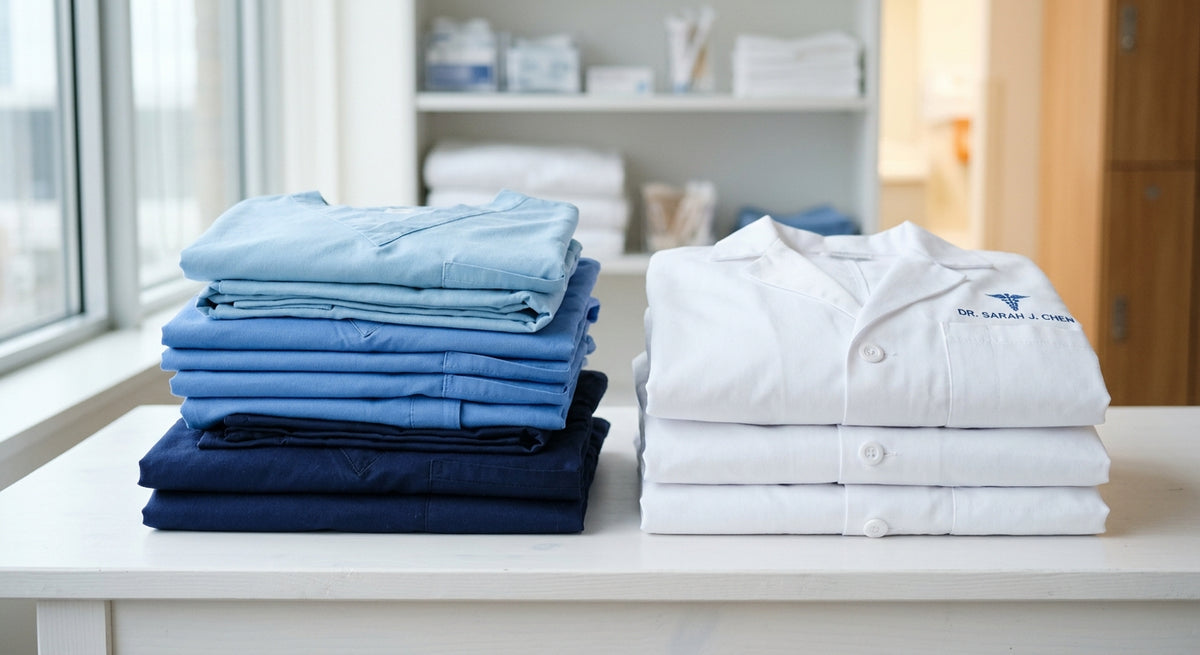
Beyond daily laundry mechanics, maintaining the structural integrity of your medical wardrobe relies on establishing a disciplined inventory rotation. Subjecting individual garments to continuous wash-wear cycles without resting the synthetic stretch fibers accelerates elasticity loss and seam fatigue. When outfitting your clinical team with premium women's scrubs, assign at least three to four complete sets per full-time practitioner to prevent rapid fabric burnout. Similarly, providing well-fitted men's scrubs across multiple shifts reduces operational wear, allowing moisture-wicking and four-way stretch fibers time to recover between cycles. For supervisory staff, physicians, and clinic directors, keeping structured lab coats on contoured wooden or heavy plastic hangers between shifts maintains lapel shape and reduces the need for aggressive, fabric-scorching ironing. Partnering with Zenir Wholesale ensures you receive commercial-grade garments engineered to withstand frequent industrial washing while maintaining vibrant colors and refined tailoring.
Ready to upgrade your clinic or medical facility with durable, high-performance wholesale lab coats and bulk scrubs? Explore the complete collection at Zenir Wholesale today to discover premium medical workwear designed for effortless maintenance, long-lasting performance, and all-day comfort.